


 Settings
 Gift Card
 Blog
Blog Locate Us
 Partnership

10 Interesting Facts About Chefs That Explain Why Private Dining at Home Works
Most people underestimate what a professional chef actually knows. The training is longer, the technique more precise, and the culinary knowledge far deeper than a restaurant menu suggests.
These interesting facts about chefs reveal what years of professional kitchen experience look like and why that expertise translates so naturally into an exceptional private dining experience at home.
1. Chefs Train in Flavor Science, Not Just Cooking
One of the most compelling facts about being a chef is how deeply training in food science goes. Professional chefs study flavor compounds, heat reactions, emulsification, and texture dynamics as part of their formal culinary education.
The balance of acidity, fat, salt, and heat in a dish is not intuitive for most people. For a trained chef, it is a disciplined framework applied to every single plate.
2. Culinary Training Takes Years of Structured Study
Among the most underappreciated facts about culinary arts is the length and rigor of professional training. Culinary school programs range from one to four years, followed by apprenticeships working under senior chefs in professional kitchen environments.
The American Culinary Federation and equivalent bodies worldwide maintain certification standards that professional chefs must meet and renew throughout their careers.
3. Professional Chefs Are Food Safety Certified
One of the most practically important fun facts about chefs is how seriously they take food safety. Professional chefs working in private residences hold ServSafe certification, issued by the National Restaurant Association, which covers:
- Temperature control and safe food handling
- Cross-contamination prevention protocols
- Allergen identification and management
- Safe food storage standards
For in-home dining, this certification is what separates a professional from a talented amateur.
4. How Chefs Handle Every Dietary Restriction at Your Table
Trained chefs treat dietary restrictions as a creative brief, not an obstacle. Managing multiple simultaneous needs within a single multi-course menu is a standard professional skill.
A professional chef accounts for every person at the table before a single ingredient is purchased, building the entire menu around the full dietary picture rather than accommodating restrictions as an afterthought.
5. Setup Is a Professional Discipline
Mise en place, French for everything in its place, is the foundational discipline of every professional kitchen.
Before a single burner is turned on, every ingredient is measured, prepped, and positioned. Every timing sequence is planned. When a professional chef works in a private home, this same standard applies, resulting in a kitchen that stays calm and a meal that feels effortless from the outside, regardless of its complexity.
6. Knife Skills Are a Formal Qualification
In professional culinary training, knife skills are a formal qualification covering precision cuts, blade maintenance, safety protocols, and consistency of size and shape across large volumes of ingredients.
Uniformity of cut affects cooking time, texture, and presentation simultaneously. The quality of a brunoise or julienne in a professionally prepared meal is functional precision, not decoration.
7. Chefs Specialize in Global Cuisines at a Deep Level
Professional culinary training builds on classical French technique, extending into regional and global cuisines. Many chefs spend years studying Italian, Japanese, Indian, or Middle Eastern culinary traditions under specialist chefs from those backgrounds. This depth of specialization is one of the more interesting facts about chefs and is directly relevant when building a private dining menu around a specific cuisine.
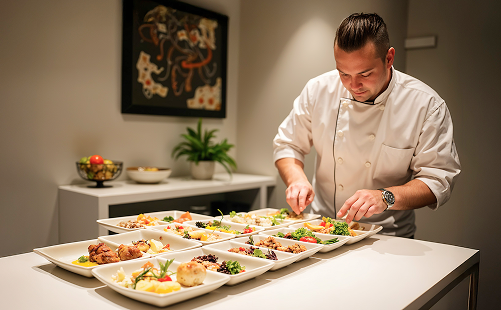
8. How Chefs Apply Michelin-Level Plating at Home
Presentation at the highest level of professional cooking follows defined principles around balance, color contrast, negative space, and portion geometry.
These are trained standards, not aesthetic preferences.
A trained chef applies these same principles in a private home setting. The visual quality of a professionally plated dish at home is the direct result of years of presentation training.
9. Every Private Chef Menu Is Built for One Table Only
Before any engagement, a professional chef works through the client’s preferences, dislikes, dietary requirements, allergies, preferred cuisines, and the occasion itself.
The result is a menu that exists for one table, on one evening, for a specific group of people. This level of personalization is structurally impossible in a restaurant where a fixed menu serves hundreds of covers per night.
10. The Private Chef Relationship Improves with Every Meal
One of the most interesting aspects of being a chef in a private setting is how the relationship evolves over multiple engagements. A chef who has cooked for the same household more than once knows the preferences of every person at the table, the standards expected, and the occasions that matter.
The food improves with familiarity. The experience becomes more personal with every visit.
What These Facts About Chefs Mean for Dining at Home
Private dining at home with a professional chef delivers restaurant-level quality in a setting that is entirely your own. Here is what that looks like in practice:
- Menu built specifically for your table and every dietary need at it
- Fresh ingredients sourced and brought to your kitchen.
- Michelin-standard plating and course timing throughout the meal
- Complete kitchen cleanup before the chef leaves
It is a considered choice about how food, time, and the people around your table deserve to be treated.
Frequently Asked Questions
Years of formal training, food safety certification, and precision techniques most home cooks never develop.
It guarantees food safety standards covering allergen management, temperature control, and cross-contamination prevention in your kitchen.
Yes. Managing gluten-free, nut allergy, plant-based, and other needs simultaneously is standard professional chef training.
Completely. Every menu is built around your taste preferences, dietary needs, and the specific occasion.
Michelin-level plating, global cuisine specialisation, formal knife skills, and flavour science trained over years of professional experience.







 Home
Home
 Chefs
Chefs
 Chats
Chats
 My Order